

What Are Spectrum Analyzers?
Whether you’re streaming a video, managing a wireless network, or developing new electronic products, all of these experiences rely on invisible signals that work quietly in the background.
We rarely think about them until something goes wrong—your Wi-Fi drops, your Bluetooth headphones crackle, or a device fails a compliance test.
To prevent these issues, engineers constantly monitor and assess signal behaviour. That’s where spectrum analyzers come in.
You may have never handled a spectrum analyzer yourself, yet their work affects nearly every modern-day technology we interact with.
They help maintain mobile coverage, ensure new consumer electronics don’t interfere with other devices, and even keep industrial automation systems running reliably.
By understanding what these tools do exactly, as well as why they matter, you gain a clearer picture of how engineers keep technology stable, efficient, and compliant in a very crowded signal environment.
What is a Spectrum Analyzer?
Spectrum analyzers are a type of frequency-domain instrument that show signal amplitude across a range of frequencies.
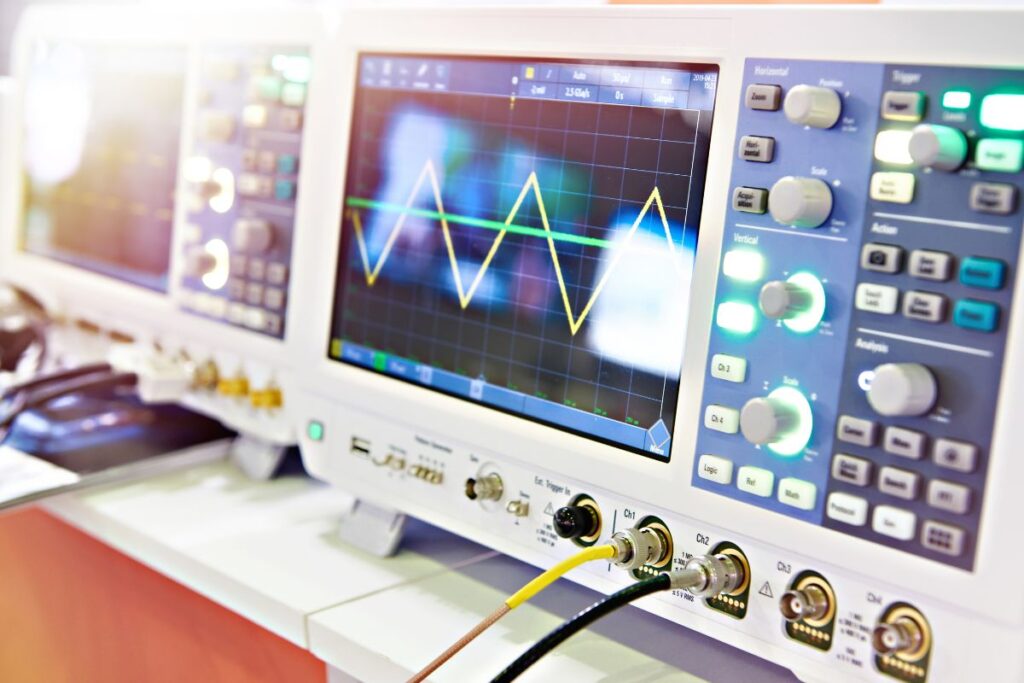
Instead of showing how the signal changes over time, as an oscilloscope does, these analyzers focus on how strong each frequency component appears within a given band.
This view ultimately allows you to identify lots of things, including unwanted harmonics, spurious emissions, and the occupied bandwidth.
Think of it like breaking down a complex piece of music into individual notes. You are no longer listening to the melody but instead seeing the strength of each note all at once.
This frequency-domain view gives engineers a far deeper insight into what’s really happening inside a signal, making the tools essential for ensuring signals are clean, stable, and fall within limits set by certain regulations or requirements.
How Spectrum Analyzers Work
When you connect a signal source, the analyzer basically ‘dissects’ the signal so you can assess its purity and behaviour.
This allows you to check power levels, monitor noise, and determine whether the signal stays within the expected boundaries.
Engineers usually divide spectrum analyzers into two main types: analogue and digital.
- Analogue spectrum analyzers rely on a local oscillator and filters to ‘sweep’ across a range of frequencies. They operate in a way similar to tuning a radio, scanning one slice of the spectrum at a time.
- Digital spectrum analyzers, on the other hand, use a mathematical process called the Fast Fourier Transform (FFT) to analyse the signal. Instead of sweeping, they capture an entire frequency scan at once, making it significantly faster at catching brief, intermittent “glitch” signals that an analogue sweep might miss.
Key Applications in Tech and Business
Spectrum analyzers are used across multiple industries to ensure systems remain reliable and compliant.

For example, telecommunication engineers use spectrum analyzers to optimise mobile networks, minimise dropped phone calls, and locate sources that may disrupt 5G, Wi-Fi, or satellite communications.
Small bursts of interference can knock out coverage in a local area, so rapid detection is key.
Similarly, broadcast and media companies rely on the analyzers to verify signal stability and avoid overlap between stations.
Even the slightest shift in frequency can cause audio or video quality issues. They are also used by research and development teams to analyse prototypes, fine-tune antenna designs, and again, validate signal quality.
Catching potential issues at this stage early on helps companies avoid costly redesigns down the line.
When interference does occur, engineers track its “frequency fingerprint,” identify the culprit, and work to resolve the issue.
Sometimes it’s a faulty power supply, a misconfigured transmitter, or even a nearby device unintentionally radiating noise
Choosing the Right Tool for Your Needs
Spectrum analyzers are becoming more important as technology advances and are predicted to reach a market share value of $2.95 billion by 2034, ultimately driven by the expansion of wireless systems, IoT devices, and increasingly tight regulations.
When selecting an analyzer, you need to match the specifications to your real-world tasks and requirements and consider a range of different things.
This includes frequency, which determines the signals you can measure. Resolution bandwidth also needs to be thought about as it can affect how well you can separate closely spaced signals.
If you’re in the field and constantly on the move, portability also needs to be considered. Handheld or battery-powered units may be beneficial for those on the move, while those operating in labs may prefer high-performance bench-top models.
Therefore, it is important to consider how you plan to use the analyser day to day, then choose a model that supports those tasks and fits seamlessly into your routine.


